
Renewable Energy Framework
The University of Utah Recognized for Adopting Large-Scale Renewable Energy Framework
By Lissa Larson, ENV SP, Senior Project Engineer, Sustainability & Energy
The University of Utah has committed to Carbon Neutrality by 2050, a foundational strategic initiative. Most of the U’s carbon footprint (60%) is the energy used by buildings, such as natural gas heating and electricity. As a result, achieving carbon neutrality is impossible without using large-scale renewables.
In the last three years, the University has collaborated with Rocky Mountain Power to be the first to utilize a new billing rate for electricity transmission. The new rate creates a framework for large-scale users to purchase power from renewable energy projects, supporting the development of new installations across the region. With the new rate in place, the University signed a long-term purchase of geothermal energy from the Soda Lake Field in Nevada, which financed a system overhaul and upgrade to the existing plant. In 2020, the University also signed a 25-year contract with the Castle Solar Project near Huntington, Utah, to provide 20MW of electricity.
This monumental coordination and continued commitment
to renewables are now getting the U noticed.
The University of Utah has been highlighted for its renewable energy commitments in
the 2021 Sustainable Campus Index by AASHE, the Association for the Advancement of Sustainability in Higher Education.
The U is one of only 143 institutions worldwide to earn a STARS Gold rating or better. This year’s Sustainable Campus Index recognizes the U’s groundbreaking
geothermal energy purchase with Cyrq Energy and Rocky Mountain Power.
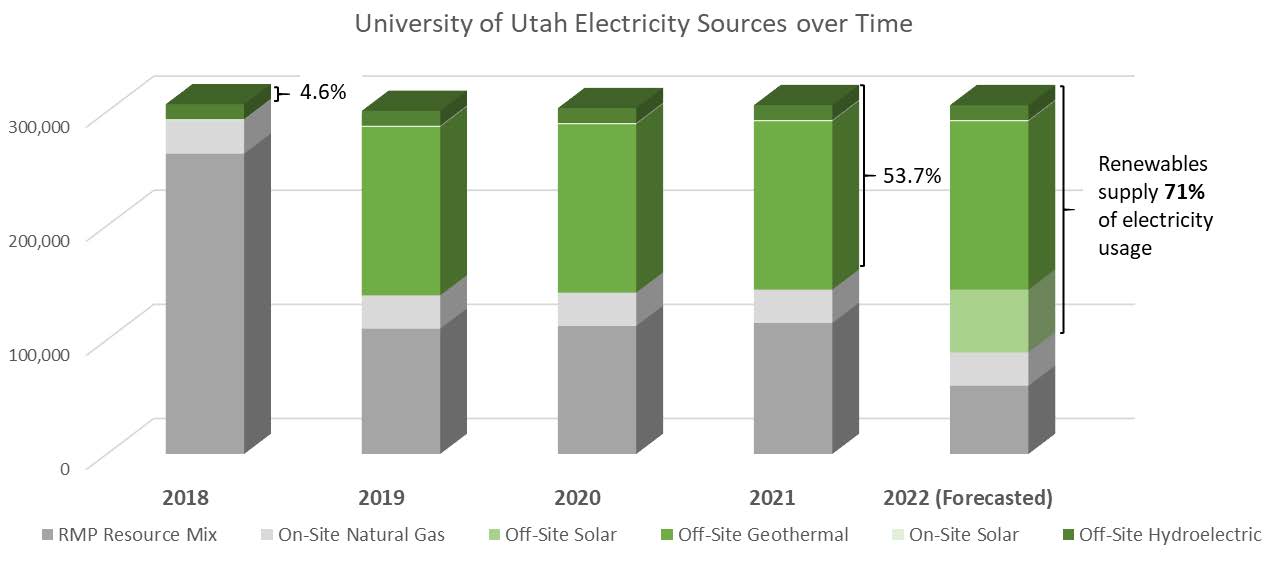
These contracts represent a significant change at the University of Utah. Before 2019, renewable energy supplied only 4.6% of the campus’s energy needs, primarily from small installations. Since Fall 2019, more than half of the U’s electricity (53.7%) comes from renewable energy thanks to the Cyrq Energy geothermal power purchase. With the completion of the Castle Solar Project (End of 2022), this will be 71% of the U’s electricity usage.
The University of Utah is committed to meeting Carbon Neutrality by 2050 and is excited for the partnerships and innovation that will bring us there.
A Massive Undertaking for Stakeholders
The university was researching the use of large-scale renewables before 2019, but there was a barrier to getting the power directly from proposed remote projects to interested buyers. The U’s Sustainability & Energy group, led by Associate Director Chris Benson, worked with Rocky Mountain Power to be the first to utilize a new rate tariff that could standardize the transmission of renewable energy.
“We requested proposals in 2017 -shortly after the tariff was revised -in partnership
between the Sustainability Office and Facilities,” said Benson. “One of the first
tariff barriers was the complication
of calculating costs. Using hourly comparisons of production and consumption, my team,
Energy Strategies (energy consultant), and Rocky Mountain Power did extensive modeling
and sensitivity analyses to fairly compare technologies, understand the range of impacts,
and conduct conservative analysis for decision-making. The Sustainability Office helped
seek input and buy-in from senior leaders. We then had to develop new three-way contracts
to be approved by all parties and by the Utah Public Service Commission.
For the second phase of the solar work, I worked with Dave Quinlivan of Facilities,
Jeff Johnson of Procurement, Gary Dodge (legal consultant), and SITLA (the Utah School
and Institutional Trust Lands Administration) to find an excellent complementary project.
Again, we had to confirm the new solar scope was supported by senior leadership, including
our budget office, President, and Board of Trustees. Thanks to all of this coordination,
the geothermal project began delivering power in 2019, and the Castle Solar Project
will come online at the end of 2022.”
This new rate tariff, Rocky Mountain Power Schedule 32, allows large energy users,
like the University of Utah, to power their facilities by purchasing clean energy
directly from an off-site renewable energy source. Off-site production is essential
to take advantage of economies of scale, produce electricity more efficiently, and
secure access to backup power on the grid. Public-private partnerships allow the U
to make long-term commitments that motivate an outcome without up-front capital or
managing new assets. The purchased
electricity is supplied to the grid via Rocky Mountain Power’s existing transmission
lines.
After the University forged the initial path, many community partners now utilize the Schedule 32 rate tariff for similar large-scale renewable energy agreements.
Why Geothermal?
With the new tariff in place, the University issued a request for bids to determine which renewable energy resource and supplier best fit the University’s needs. The University’s goal was to identify a renewable resource for the U’s baseload energy needs (i.e., continuous, all-day usage) and complement existing peak renewable sources, like solar energy (i.e. higher demand in the afternoon and early evening).
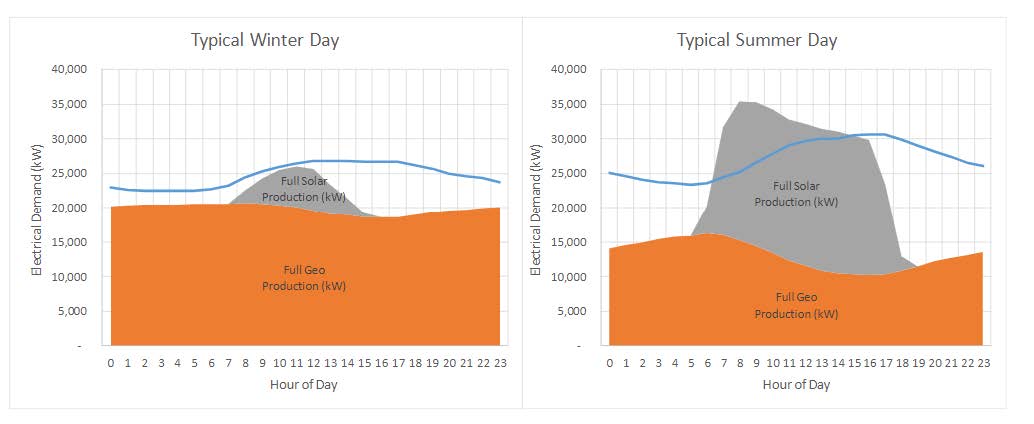
After significant review of the proposals, geothermal energy was identified as an
ideal baseload source since it is not dependent on operating conditions, like solar
or wind. Geothermal plants can supply energy consistently and predictably, which pairs
well with solar resources that produce the most during peak demand periods. Baseload
sources, like geothermal, also minimize the need to store energy with batteries since
the energy demand and supply curves can be more closely matched. These different renewable
energy technologies work together to comprise a balanced, diverse green power portfolio
for the University.
The geothermal energy purchase also did not require drilling any new wells but instead overhauled and upgraded an existing plant in Nevada, the Soda Lake Field. The Soda Lake Field has been online for 30 years and is well-studied. At the plant, Cyrq decommissioned older infrastructure and constructed a new, more efficient, and greater-capacity geothermal production plant in its place.
Signed in 2018, the energy purchase is the first of its kind and second-largest long-term geothermal power purchase agreement for an educational institution. Significant time and effort were spent for creating and negotiating 3-way contracts between the University, Rocky Mountain Power, and Cyrq Energy, which then were approved by the Utah Public Service Commission. This geothermal energy purchase and that new rate tariff, Schedule 32, opened the door for the U and other large energy users to pursue more green energy projects, such as the 20 mega-watt Castle Solar Project.
Significant Changes to Energy Sources
Most of the U’s carbon footprint (60%) is the energy used by buildings, such as natural gas heating and electricity. Electricity is supplied by various sources, including off-site and on-site solar installations, off-site hydroelectric; on-site natural gas cogeneration; and the standard electricity portfolio. The Utah generation resource mix, or electricity portfolio, is characterized by eGRID 2019 as 64.5% coal and 24.0% natural gas. Therefore, cutting down our consumption of the standard electricity portfolio directly reduces the greenhouse gas emissions from the coal and natural gas electricity generation.
Since electricity usage is a significant proportion of our carbon footprint, the geothermal agreement alone reduced the U’s total carbon footprint by over a third. Wider Utah also feels these impacts since the University accounts for about 1% of all electricity usage in the state.
Power purchase agreements have another benefit – the terms set fixed, predictable
pricing throughout the contract duration. By comparison, natural gas has been a low-cost
energy source in the US for the past fifteen years; however, forecasts projected a
price increase of 30% in the 2021-2022 Winter season. Since there is a more extended
duration contract for planning finances, the power purchase agreement can set a
reasonable rate over the contract’s lifetime as an accounting benefit to both parties.
If technology or
electrical loads change significantly, the University still maintains the option to
re-evaluate or re-sell unused electricity to a third party.
This work is only possible through the work of the Sustainability & Energy group in Facilities, the more extensive Facilities department, and the Office of Sustainability. The University of Utah is committed to meeting Carbon Neutrality by 2050 and is excited for the Castle Solar Project progress, which is scheduled to be online by the end of 2022.